* Reference
[1] Hoerner, S. F., 1965, Fluid-Dynamic Drag: Theoretical, Experimental, and Statistical Information
[2] Mason, W. H., 2006, ConfigAeroDrag
[3] Jobe, C. E., 1984, Prediction of Aerodynamic Drag, AFWAL-TM-84-203
[4] Marino, A ., et al., 1975, Evaluation of Viscous Drag Reduction Schemes for Subsonic Transport, NASA CR-132718
[5] Sawyer, R. H., and Trant, Jr. J. P., 1950, Effect of Various Modifications on Drag and Longitudinal Stability and Control Characteristics at Tansonic Speeds of a Model of the XF7U-1 Tailess Airplanes, NACA RM SL50D18
[6] Edwards, J. B. W., 1964, Free-Flight Measurements of the Zero-Lift Drag of a Slender Ogee Wing at Transonic and Supersonic Speeds, Ministry of Aviation, Aeronautical Research Council
[7] Katz, E., 1949, Flight Investigation from high subsonic to supersonic speeds to determine the zero-lift drag of a transonic research vehicle having wings of 45 deg sweepback, aspect ratio 4, taper ratio 0.6, and NACA65A006 airfoil sections, NACA RM L9H30
[8] Leiss, A., 1952, Flight Measurement at Mach Numbers from 1.1 to 1.9 of the Zero-Lift Drag of a Twin-Engine Supersonic Ram-Jet Configuration, NACA RM L52D24
[9] Hoffman, S., and Chaubin, L. T., 1961, Aerodynamic Heat Transfer and Zero-Lift Drag of a Flat Windshield Canopy on the NACA RM-10 Research Vehicle at High Reynolds Numbers for a Flight Mach Number Range from 1.5 to 3.0, NACA RM L56G05
[10] Piland, R. O., and Putland, L. W., 1957, Zero-Lift Drag of Several Conical and Blunt Nose Shapes Obtained in Free Flight at Mach Numbers of 0.7 to 1.3, NACA RM L54A27
[11] Piland, R. O., 1957, Preliminary Free-Flight Investigation of the Zero-Lift Drag Penalties of Several Missile Nose Shapes for Infrared Seeking Devices, NACA RM L52F23
[12] Edwards, J. B. W., 1964, Free-Flight Measurements of the Zero-Lift Drag of a Slender Ogee Wing at Transonic and Supersonic Speeds, Ministry of Aviation, Aeronautical Research Council
[13] Egger, A. J., et al., 1956, Bodies of Revolution having Minimum Drag at High Supersonic Airspeeds, NACA TN 3666
[14] Stoney Jr, W. E., 1953, Some Experimental Effects of Afterbody Shape on the Zero-Lift Drarg of Bodies for Mach Numbers between 0.8 and 1.3, NACA RM L53I01
[15] Ulman, E. F., and Dunning, R. W., 1954, Normal Force, Center of Pressure, and Zero-Lift Drag of Several Ballistic-Type Missiles at Mach Number 4.05, NACA RM L54D30a
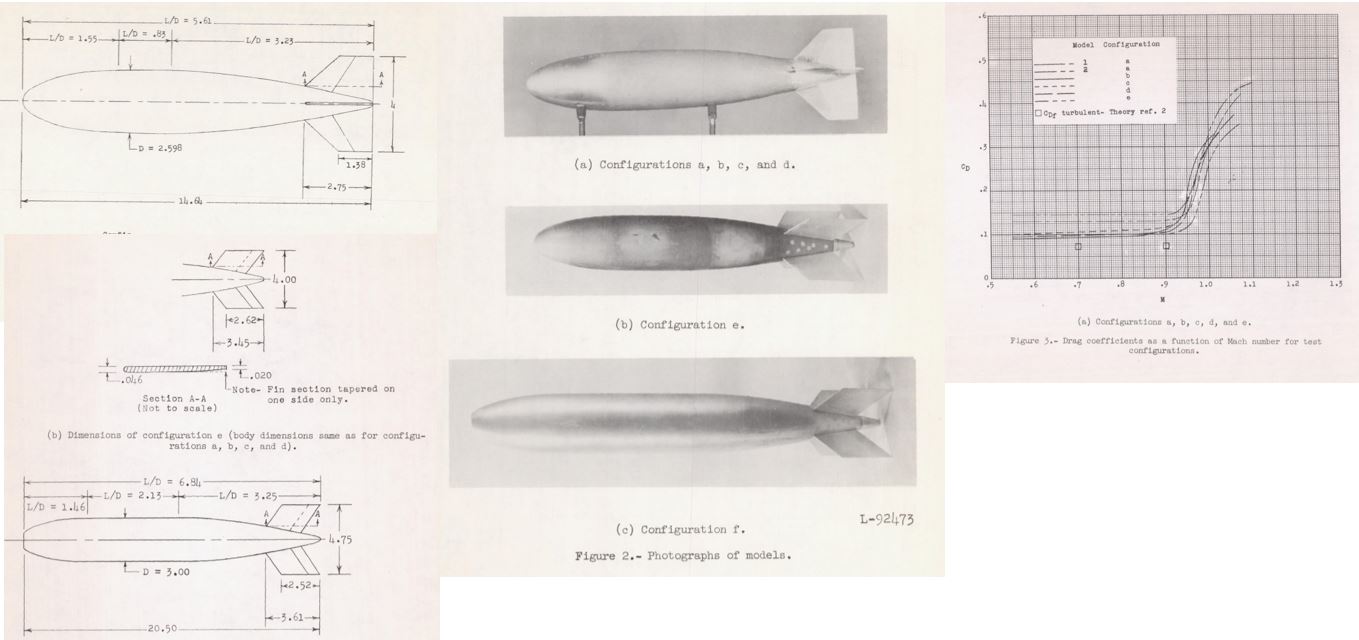
[16] Stoney, W. E., and Royall, J. F., 1956, Zero-Lift Drag of a Series of Bomb Shapes at Mach Numbers from 0.6 to 1.1, NACA RM L56D16
[17] Hoffman, S., 1959, Zero-Lift Drag of a Large Fuselage Cavity and a Partially Submerged Store on a 52.5 deg Sweptback-Wing-Body Configuration as Determined from Free-Flight Tests at Mach Numbers of 0.7 to 1.53, NACA RM L56L21
[18] Whitcomb, R. T., 1956, A Study of the Zero-Lift Drag-Rise Characteristics of Wing-Body Combinations near the Speed of Sound, NACA Report 1273
[19] Howell, R. R., and Braslow, A. L., 1957, Experimental Study of the Effects of Scale on the Absolute Values of Zero-Lift Drag of Aircraft Configurations at Transonic Speeds, NACA RM L56J29
[20] Shrout, B. L., 1965, Zero-Lift Drag at Mach 1.42, 1.83, and 2.21 of a series of wings with variations of thickness ratio and chord, NASA TN D-2811
[21] Henderson Jr. A., 1955, Experimental Investigation of the Zero-Lift Wave Drag of Seven Pairs of Delta Wings with Constant and Varying Thickness Ratios at Mach Numbers of 1.62, 1.93, and 2.41, NACA RM L55D13
[22] Merlet, C. F., 1955, The Effect of Inlet Installation on the Zero-Lift Drag of a 60 deg Delta-Wing-Body Configuration from Flight Tests at Mach Numbers from 0.8 to 1.88, NACA RM L55I09
[23] Smith, R. C., et al., 1987, Summary of Studies to Reduce Wing-Mounted Profan Installation Drag on an M = 0.8 Transport, NASA Technical paper 2678
[24] Moraes, C. A., and Nowitzky, A. M., 1954, Experimental Effects of Propulsive Jets and Afterbody Configurations on the Zero-Lift Drag of Bodies of Revolution at a Mach Number of 1.59, NACA RM L54C16
[25] Kulfan, R. M., 1979, Prediction of Nacelle Aerodynamic Interference Effects at Low Supersonic Mach Numbers, NASA CP-2108
[26] Mackay, M., 1993, A Review of Sting Support interference and Some Related Issues for the Marine Dynamic Test Facility, AD-A271 806
[27] Chima, R. V., 2012, Analysis of Buzz in a Supersonic Inlet, NASA/TM-2012-217612
[28] Page, W. A., 1957, Influence of the Body Flow Field on the Zero-Lift Wave Drag of Wing-Body Combinations Modified in Accordance with the Transonic Area Rule, NACA RM A55K10
[29] Fuller, F. B., and Briggs, B. R., 1951, Minimum Wave Drag of Bodies of Revolution with a Cylindrical Section, NACA TN 2325
[30] Holdaway, G. H., and Mersman, W. A., 1956, Application of Tchebichef Form of Harmonic Analysis to the Calculation of Zero-Lift Wave Drag, NACA RM A55J28
[31] Lomax, H., 1955, The Wave Drag of Arbitrary Configurations in Linearized Flow as Determined By Areas and Forces in Oblique Planes, NACA RM A55A18
[32] Miele, A., 1966, Similarity Laws for Lifting Wings of Minimum Drag at Hypersonic Speed, NASA CR70729
[33] Adams, M. C., 1951, Determination of Shapes of Boattail Bodies of Revolution for Minimum Wave Drag
[34] Llorca, I. B., 2015, CFD Analysis and Assessment of the Stability and Control of a Supersonic Business Jet, KTH
[35] Kulfan, B., 2009, New Supersonic Wing Far-Field Compsite Element Wave-Drag Optimization Method, J. Aircraft
[36] Cartieri, A., and Boyet, M. G., 2010, Study of Support Interference Effects at S1MA Wind Tunnel within the “SAO” Project, ICAS 2010
[37] Willhite, P., et al., 1995, A Critical Evaluation of CFD Predictions of Full Aircraft Drag Increments, 26th AIAA Fluid Dynamics Conference, AIAA 95-2289
[38] Slater, J. W., 2012, Design and Analysis Tool for External-Compression Supersonic Inlets, NASA/TM-2012-217660
[39] Keye, S., and Gammon, M. R., 2017, Development of Deformed Computer-Aided Design Geometries for the Sixth Drag Prediction Workshop, J. Aircraft
[40] Gregg, R., 2014, CFD and Aircraft Design, Boeing