Table of Contents

Aerodynamics Series

레이블이 France인 게시물을 표시합니다. 모든 게시물 표시

2020년 4월 23일 목요일

German decides replacement for Tornado ECR and IDS(?)


Previous related Articles


 German's Luftwaffe decide to buy 30 Super Hornet w/ Nuclear capability and 15 Growler as a replacement for the aged Tornado IDS and ECR (https://theaviationgeekclub.com/germany-approves-super-hornet-growler-buy-to-replace-luftwaffe-tornado-fighter-bombers/). 

 As shown in the Airbus' plan, France and German try to develop a New jet fighter for their own Air-Force, however, aged Tornado fleet probably needs more urgent replacement than the mock-up stage aircraft. Indeed, Super Hornet would be selected as a new platform of the Luftwaffe. 

 Now, Boeing, maker of Super Hornet, has new customer for its manned military jet fighter, and they could propose their upgrade options like weapon pod or conformal fuel tank. (https://jaesan-aero.blogspot.com/2018/02/weapon-pod-for-super-advanced-hornet.html)

 Interesting point is that Luftwaffe also orders more Eurofighter as a partner of the Super Hornet. Super Hornet is generally regarded as a more Air-to-Ground mission platform than the Eurofighter. Although Eurofighter tried to expand their role to AtG mission, German might not satisfy the compatibility of the Eurofighter. 

 It will be interesting that German requires Nuclear capability for the Super Hornet. And what will be other 'German Options' for the Super Hornet?


2019년 11월 3일 일요일

Missile-SIM : Effectiveness of Rocket motor for free-fall bomb


Previous Work Status

Initial Version of Missile-SIM for Performance evaluation
Aerodynamic Validation of Missile-SIM for Trajectory 
AIM-120C Study using Missile-SIM : Part 1 - Sensitivity
AIM-120C Study using Missile-SIM : Part 2 - Launch Condition
AIM-120C Study using Missile-SIM : Part 2 - Launch Condition - revision
Patch note of Missile-SIM : Guidance Algorithm is added w/ Real-Time plot
W.I.P status of Missile-SIM : Addition of Air-propulsion part 1
W.I.P status of Missile-SIM : Addition of Air-propulsion part 2
AIM-120C Study using Missile-SIM : Part 3 - CUDA / LREW / METEOR types. 1 : Baseline Comparison
AIM-120C Study using Missile-SIM : Part 3 - CUDA / LREW / METEOR types. 2 : Sensitivity Analysis
AIM-120C Study using Missile-SIM : Part 3 - CUDA / LREW / METEOR types. 3 : Few mentions
W.I.P status of Missile-SIM : Addition of 3D Coordinate
W.I.P status of Missile-SIM : Development of Few generic bodies for Further Missile-SIM
Missile-SIM : Performance Evaluation for ATACMS class missile
Missile-SIM : Performance Evaluation for KM-SAM class missile


 1. Modeling of Generic AASM

 AASM is a kind of munition that adding rocket motor on the free-fall bomb to increase its effectiveness. 

 CFD work was not done for AASM; I just assumed AASM has own weight, given rocket motor and generic body shape from the previous study


 2. Trajectory Simulation of AASM

1) Baseline case : Generic Free-Fall (No rocket-motor)


Trajectory or range of the free-fall bomb is very sensitive to initial condition of the launch aircraft. I simulated two condition, 15kft and 30kft with M0.8 cruise. They represent 4.5km and 9km range when I set the course of -45deg of fall. 

This can be regarded as maximum range of the GBU without any additional glider kit or rocket motor. Maximum speed of the bomb peaks around M1. 


2) Addition of 10% weight propellant 


I have added 25kg of propellant on the bomb to increase the range, and the test condition is 15kft and 30kft with M0.8. 

Speed increase of the munition is impressive (~M1.0 -> M1.5) however the increased ranges are 12km and 20km. It is also huge increase of range for percentage but still not effective against Air-Defense system. 


3) Addition 20% weight propellant (Similar to AASM)


Similar to AASM, it has 50kg of propellant for 250kg of warhead. It provides higher speed and less deeper glide angle for longer range. I have test several initial condition and trajectory specifications. 


The increased propellant gives about M2 class peak speed for the munitions, and it touch the ground supersonic speed. Both 15kft and 30kft condition makes only similar 20km which is not much difference from that of the 10% propellant case. 

Then, I feel this trajectory is not optimized for the increased propellant because not only via range also excessive terminal speed. 


This case gives more climbing trajectory that the previous ones; much more propellant make it possible. The result show that the range is increased significantly about 45km. Still there is a room for speed at peak altitude, so, range can be extended more. 


I assume the case that the low altitude penetration aircraft launches the munition; with loft profile, the munition could reach about 20km. Also in that case, there is a room for speed at peak altitude, so, range can be extended more. 

It represent that 20% weight propellant provides range from 20km+ to 50km+ depending on its launch altitude like real AASM. And it would be meaningful for SEAD operation. 

At final figure, I provide assumed result that AASM is launched at the ground. It reaches 13km while there is no enough room for range extension. So, it could explain why more bigger missile is needed for ground-launch. 


 3. Conclusion

Addition of the rocket-motor on the conventional weapon is effective way to increase the range and speed of the weapon while the portion of the propellant should be more than 20%. 

Modern short-or-mid-range air-defense system has range about 50km, and range of the generic AASM type weapon can over it when the portion is about 20%. This could explain how AASM has such a rocket-motor. 

Addition of glider-kit on the bomb is another method to increase the range rather than the rocket motor. I expect that amount of the increased range can be similar in both way depending on their specification. However, rocket motor has definite advantage over the kit for its speed, response time, and range-independence from launch platform. 

(Although glider kit is cheaper than the rocket motor)

2019년 10월 19일 토요일

ADEX 2019 Korea PART. 1 - Internal Booth


I had visited ADEX 2019 for two days (Wednesday for Business, and Saturday for Public)

Photos of these two days are mixed, and please consider it.

Personally, I did not take many pictures in the booth while I would take a lot at the outside

Importantly, pictures related to KF-X will be shown in PART. 2


1) Hanwha


2) IAI (ROCKS and Rampage stand-off missiles are newly displayed)


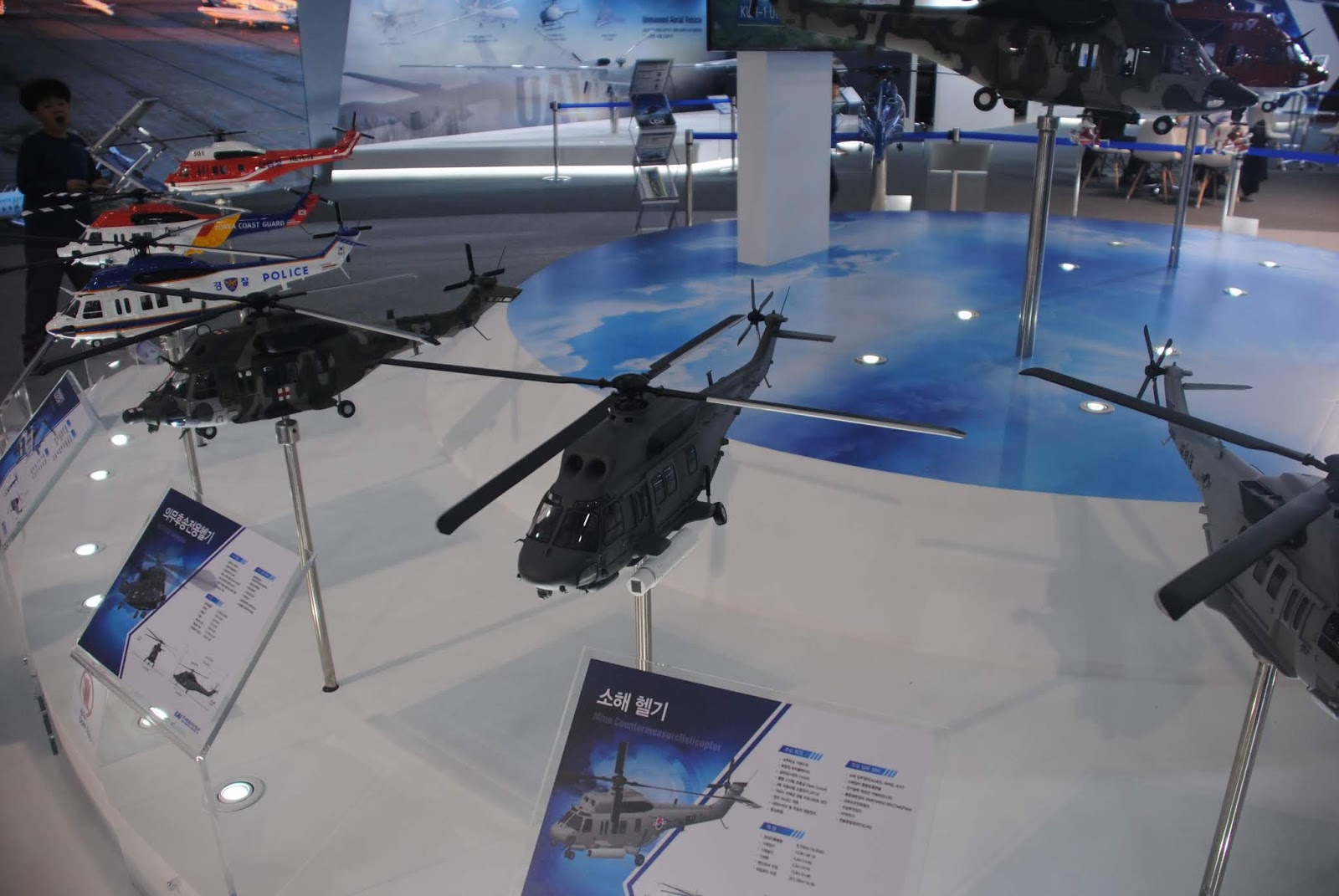
3) KAI (Sniper Pod for FA-50 and variants of KUH-1)

Big armed-wing of KUH-1 is for ROK marine while small-attached one is for the proposed export.
Anti-naval-mine version was also proposed


4) KAL


5) LIG


6) MBDA


7) SAAB


8) TAI


9) TAURUS


2019년 8월 2일 금요일

New-wing concept from Airbus


 RC-scaled demonstration of New-wing concept; wing-tip part is freely moved to adapt the flow condition. 

 Expected impact is lowering gust-load and better handling quality. 


2019년 6월 22일 토요일

Summary of Paris' Airshow 2019


 In Paris' Airshow, there are lots of contract especially for single-aisle airliners, A321XLR which could expand LCC's capabilities for longer range. 


I prepared some eye-candies and AIRBUS summary videos for this important aviation event


2019년 6월 17일 월요일

You-Tube Channel recommendation for Aviation Area


My recent favorite New-Channel for Aviation Area : it is quick and give direct news

 -> DJ's Aviation

New fighter jet proposal for Replacement of Tornado jet...(5) - French-German New Jet Fighter


As a consequence of proposal of French-German New jet fighter

Previous related Articles

 -> Small Note for Concept of 6th Generation Fighters : And Future Aerial-Warfare

 -> French-German's proposal for replacement of Tornado jet

 -> French-German's proposal for replacement of Tornado jet (2)

 -> French-German's proposal for replacement of Tornado jet (3)

 -> French-German's proposal for replacement of Tornado jet (4)


 Now, There are some updates for this jets from Paris Air Show. Compare to its previous concept art, additional V-tails are noticeable while fore-body part including LEX, intake is heavily modified. 

 Also, two-seated concept seems to be abandoned. In overall, previous art is similar to Pak-Fa, however, now, it is more similar to F-35 or Tempest from BAE.


2019년 4월 20일 토요일

Comparison of Airliner's Wing plan-form


 Comparison of Airliner's Wing plan-form

 As my personnel interest, I figured out wing plan-form of the modern airliners. Mainly, aircraft of Airbus and Boeing are compared in few ways to find design characteristics of the wing. 

You should know that performance of the aircraft is not only determined by the plan-form also by several factors like airfoil section, structure, position-of-wing, engine performance, and drag management. I hope you to see this article as 'fun-purpose' rather than serious 'performance comparison review'. 


1) AIRBUS family


 This shows direct comparison between Airbus-families including narrow and wide-bodies. As you could see that A330 and A340 is almost identical while the new two-engine-A35K has same size as A340. 


 Now the smallest A320's wing has smallest swept angle among the Airbus', and as aircraft goes heavy, wing has more swept angle. You could see A320 and 330 has almost similar AR except change of swept angle. In normalized view, even position of the engine is similar for A320 and 330 while more swept angle of the 330's wing is compensated by frontal-position of the engine. It is interesting to see that A320 and 330. 
 Relatively newer and heavier 350 and 380 has deeper swept angle and smaller AR than previous generation because span of the wing is limited by the practical structural and space reason. Portion of the leading edge device is also become smaller in recent generation.  


2) BOEING family

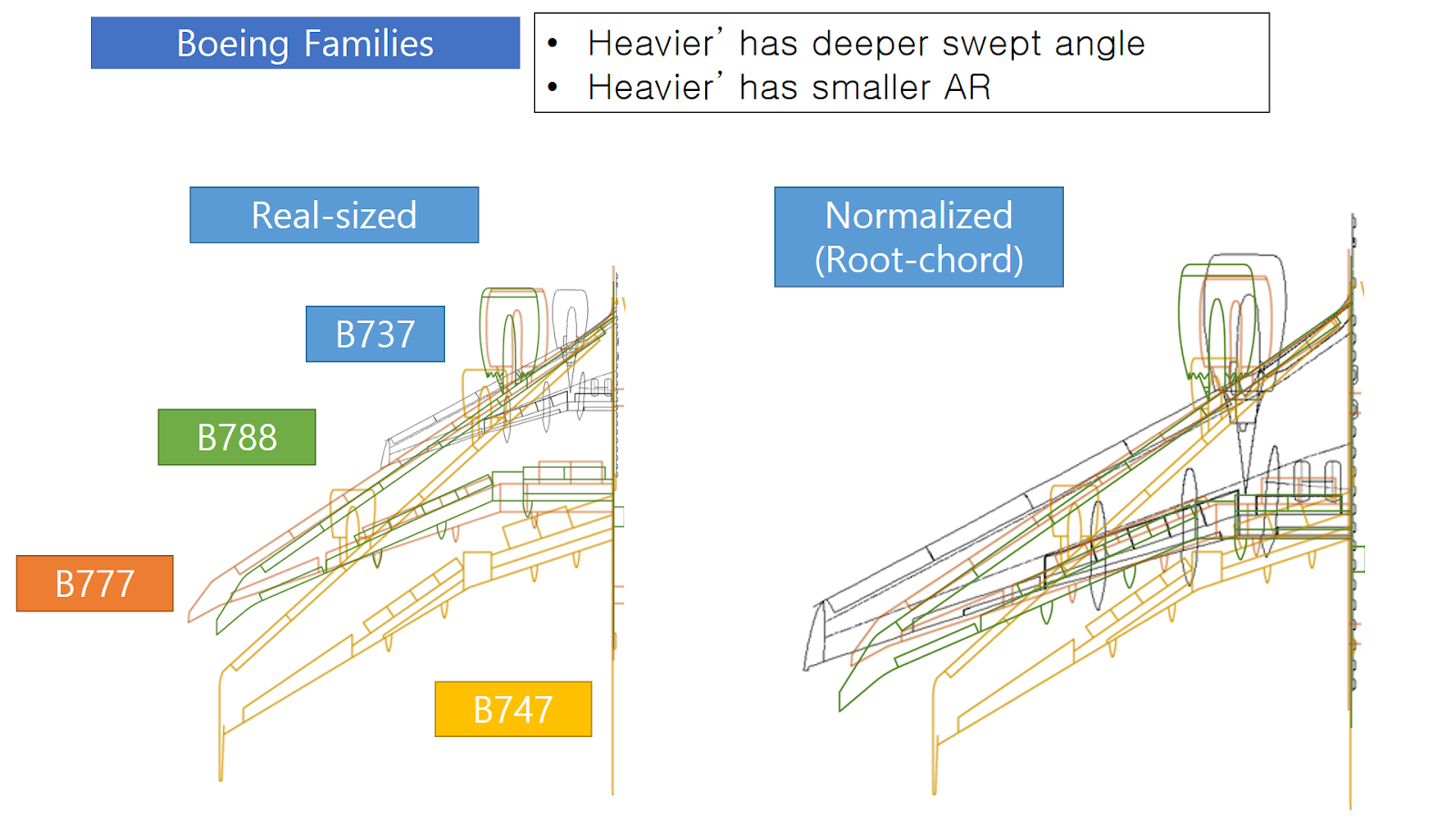
 Boeing having longer history than Airbus has more various line-up in their squad; their fancy version of classics like 777X or 747-8 will be considered in the 'Airbus-vs-Boeing'. Recent 787 and 777 show how airliner have developed in limited size for better performance.  


  You should know that trend of swept angle vs weight is kept in Boeing; heavies has deeper angle than narrow bodies or lighter ones. It showed 'engineering-convergence' strikingly strong for both of the two Airliner giants. 


3) Narrow-Bodies

 Now, we go to comparison of the two companies; both companies has their own best-seller in small-airliner class, 320 and 737. Both aircraft basically similar size however, in wing plan-form, layout is little bit different. 
 320 has more glider-like wing than 737, little bit smaller chord length with smaller swept angle. Also, 320 having longer landing gear and outer position of engine could adopt larger radius of the engine. While 320 has longer root section and outer aileron part. 
 If both aircraft have same airfoil section, 320 seems better efficiency at low speed region. We already know that low-speed region, take-off, climb, descent, and landing, takes relatively large portion of the flight-profile of narrow-bodies. 


 I have added 757 for this comparison, larger narrow-bodies, which will be replaced by Boeing's future NMA called 797. Basically, blue and green line has almost same profile except AR and engine position. In order to overcome the weight increase of 757, root-chord length is extended and engine is positioned at outer position. 


4) 330 vs Boeing's

 Tendency of 320 vs 737 is kept here; Airbus has smaller swept angle and root chord length. While 330 has longer span than 767, much frontal-position of the engine. 


 Newer 787 series has wider wing-span than 767 and become similar. Still, Boeing has deeper swept angle, and wider engine position for larger engine. 


 For three airliners, 330, 767, and 787, except engine position, Boeing family has similar layout than Airbus. Advanced wing-tip shape and longer root-section are noticeable for 787; it corresponds higher lift efficiency and heavier weight. 


 For two aircraft, difference of the swept angle is smaller than other two family comparison. Also, position of the engine is similar while 777 has longer span and root-chord length for its heavier weight. You could see that engine of the 777 is very large for its era. 
 Raked wing-tip makes noticeable difference at the tip. 


5) 350 vs 787 - Newest line-up

 Most striking feature of this comparison is here. Their newest aircraft from clean sheet is very similar for wing plan-form; only difference is probably its sizing scale. Generally, 350 is larger aircraft however, even layout of control surface is similar for each other. 
 We should watch Boeing's NMA that how they designed the wing plan-form from clean sheet; NMA is similar to 350 and 787 style or not. 


6) 350 vs 777 - Between Two-flag ships


 Actually, size of the 350 is positioned between 777 and 787, so comparison for the 350 is also done for 777. As the 350 is changed from glider-style to 787 style, now you could see Airbus has deeper swept angle than the Boeing's Classic. 777 has narrower engine position than 350 although they had larger radius engine. 
 777x extend its span and give smaller swept angle than previous aircraft to overcome increased weight. It is noticeable that making smaller swept angle is not recent trend.  


 7) 380 vs 747 - Four-engine symbols 

 Giants of two airliner giants, 380 and 747, are compared; 380 is 25% larger than 747 based on MTOW. Definitely, 380 has much larger wing than 747; it has smaller swept angle, wider span, and longer chord length. 
 Even, wings are normalized, 380's wing has bigger AR. 


 Now, we move on to add new generation of the 747-8, 


 748 has new wing with wider span, wing-tip and bigger engine. Its wing-tip is similar to 777 style. However, still, 380 is much larger aircraft than 747. Comparison of style is more convenient at normalized configuration. 
 In normalized configuration, position of the engine become very similar for 748. Modified 748 now has larger AR via added raked wing-tip. 


 8) Summary

* Mostly, Airbus has smaller swept angle than Boeing's similar class (320 and 330)

 * 330 and 340 is almost same configuration

 * Heavies has deeper swept angle and longer chord than narrow-bodies for both Airbus and Boeing

 * The newest clean-sheets, 350 and 787, has very similar design; Airbus now has highly swept one

 * New generation of Boeing, 777x and 748, has extended wing-tip

 * 777x has smaller swept angle than its predecessor; becoming Airbus style (?)